


Amazing Facts
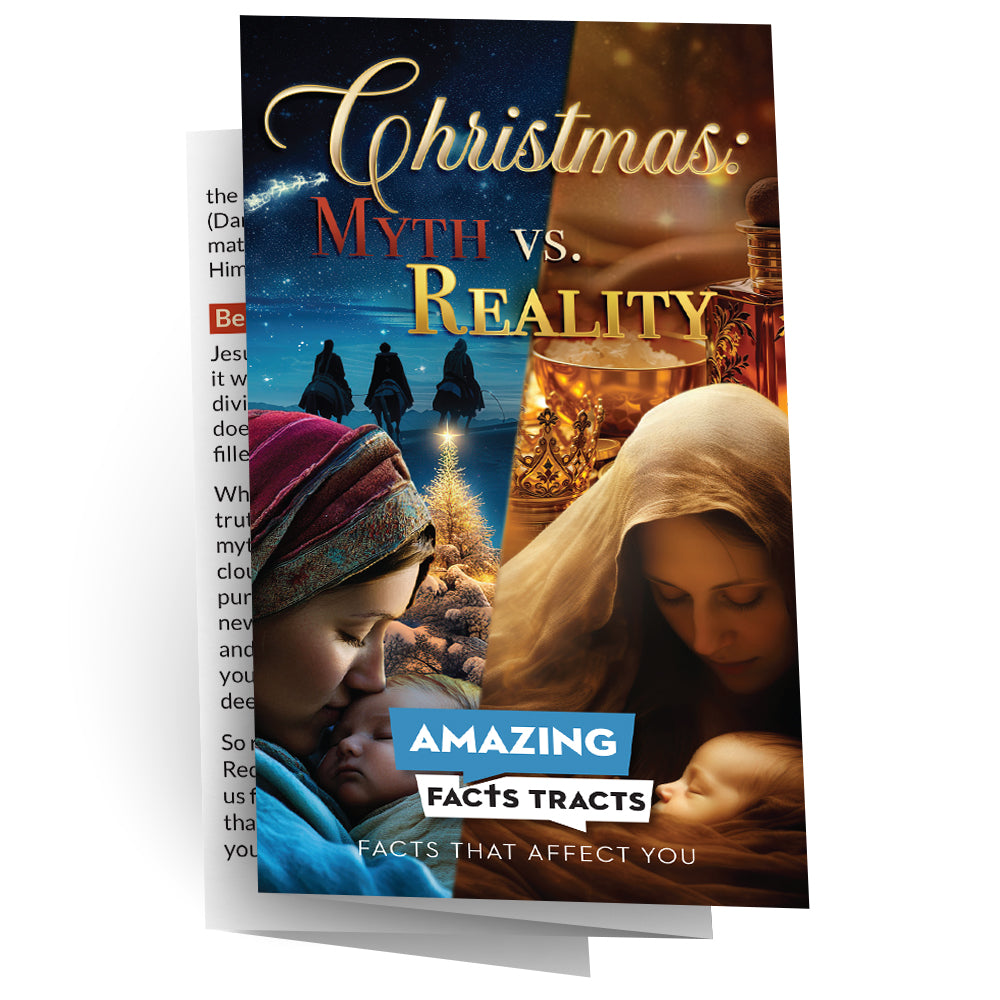
AFacts Tracts (100/pack): Christmas: Myth vs Reality
AFacts Tracts (100/pack): Christmas: Myth vs Reality
1
6615 Sierra College Boulevard
Granite Bay CA 95746
United States
Topic: Christmas
Easy-to-share leaflets on popular Bible topics!
Packets of 100 for only $9.95.
Amazing Facts Tracts stand out from the crowd.
- Larger size to grab attention (but still fits in your pocket)
- Free link to a magazine, book, or video download
- Easy to read type
- Covers key Bible teachings
- Connects to free Bible study guides
- Use with evangelism tracking database
- Nurture leads with follow-up emails on the tract topic
Equip yourself, your members, your personal ministries team, and your outreach events with these colorful, inexpensive, eye-catching tracts that can be spread out like the leaves of autumn.
Each topic introduces a central Bible topic and then links the reader to free Bible studies and a free resource that can be downloaded simply by sending a text message. Watch for more popular topics coming soon!
Partial Text on tract:
An Amazing Fact:
Did you know that the Pilgrims didn’t celebrate Christmas when they arrived in America? In fact, from 1659 to 1681, Boston outlawed Christmas celebrations—and anyone caught violating the ban faced a fine of five shillings!
What comes to mind when you think about Christmas? Festive decorations, gift exchanges, and jolly Santa Claus? Or perhaps the nativity scene, the wise men, and the birth of Jesus? For most of us, it’s a mixed bag.
But have you ever wondered why there is such a diverse, contradictory mix of traditions surrounding the Christmas season? And how many of those beliefs accurately report what the Bible says really happened when Jesus was born?
Let’s investigate ...
A Questionable Date
It may come as a surprise, but December 25 is not Jesus’ birthday! So how did that date become associated with Christmas? Long before the birth of Christ, many cultures celebrated the winter solstice—the shortest day of the year, after which daylight hours begin to lengthen. In the Northern Hemisphere, that day is either December 21or 22, just a few days before Christmas.
One of the earliest traditions linked to Christmas is the Norse holiday of Yule, which celebrated the return of the sun around the winter solstice. More prominently, ancient Romans held two major festivals in December—Saturnalia and Sol Invictus. Saturnalia was a weeklong celebration (December 17–23) marked by merrymaking and gift-giving. Later, in AD 274, December 25 was designated as the birthday of Sol Invictus, the “Unconquered Sun.
“It wasn’t until the fourth century that Christian officials instituted Jesus’ birth as a holiday. A Roman almanac from AD 354 contains the first known record of December 25 as the date of His birth—a date likely chosen in an attempt to Christianize the pagan Roman festivals. The holiday was called the “Feast of the Nativity,” now better known as Christmas - a combination of the words “Christ” and “Mass,” the Roman Catholic rite of the Eucharist.
When Was Jesus Really Born?
The Bible provides several clues regarding the time when Mary likely gave birth to Jesus
1. Shepherds were watching their flocks in the fields by night (Luke 2:8)— something unlikely during the cold winter when sheep would be sheltered.
2. Caesar Augustus ordered a census that required travel (Luke 2:1). Roman rulers wouldn’t have mandated arduous journeys during winter’s harshest months.
3. Jesus was 33 and a half years old at the time of His crucifixion, which took place three and a half years after the start of His ministry—when He was “about 30 years of age” (Luke 3:23). Knowing that His execution took place on the day of the Passover, Nisan 14, we can work backward and determine that Christ was likely born sometime in the fall.
Another Wrong Number
The classic Christmas carol tells the story, “We three kings of orient are, bearing gifts we traverse afar.” But while the wise men did honor Jesus with three kinds of gifts—gold, frankincense, and myrrh—the Bible does not specify the number of wise men (Matthew
2:1), nor does it refer to them as “kings.”
Additionally, nativity scenes often depict the wise men as having arrived the night of Jesus’
birth. However, the Bible says, “After Jesus was born in Bethlehem … wise men from the
East came to Jerusalem” (v. 1). That would have taken weeks or even months of travel!
Moreover, when the wise men arrived, Jesus is called “the young Child,” indicating some
time had passed since His birth (v. 11).
Child of Prophecy
While many, perhaps even you, have been led to believe these Christmas myths are accurate, there are far more awe-inspiring facts to be found in the Bible.
For instance, the Old Testament book of Micah predicted 700 years in advance that the Messiah would be born in the city of Bethlehem (5:2). What makes this remarkable is that Joseph and Mary lived in Nazareth and would typically have had children there—yet
they were required to travel to Bethlehem for the Roman census noted above.
But why were Joseph and Mary required to travel to Bethlehem at all? The prophet Jeremiah—writing over 600 years earlier— foretold that a righteous King would come
from David’s royal line (Jeremiah 23:5, 6). Both Joseph (Matthew 1:1–16) and Mary
(Luke 3:23–38) were descendants of David, so Jesus’ birth in Bethlehem, the city of
David, aligns perfectly with this prediction.
“Behold, the virgin shall conceive and bear a Son, and shall call His name Immanuel” (Isaiah 7:14). This prophecy, written over 700 years before Jesus’ birth, pointed to a miraculous event: a virgin giving birth to a holy Child. By the power of the Holy Spirit, Mary conceived Jesus and gave birth to Him, an incarnate divine Being called “God with us” (Matthew 1:23).
Here’s one more: While the Bible contains no prophecy pinpointing the date of Jesus’ birth, the prophet Daniel was given a timeline for the beginning of His ministry and baptism (Daniel 9:24–27). These events in Jesus’ life match this remarkable prophecy, confirming Him as the promised Messiah.
Better Than Fiction
Jesus’ arrival in our world wasn’t random— it was foretold, intentional, and had a
divine purpose. The story of His birth doesn’t need embellishment. It is already filled with wonder!
While myths may entertain us, only the truth can transform our lives. Too often, myths about Jesus and Bible doctrines cloud our understanding of God’s true purposes. Jesus didn’t come to establish a new holiday—He came to reveal God’s love and offer salvation to everyone, including you. His true story calls us to something deeper: a relationship with the living God.
So remember, behind the myths stands a real Redeemer, born to bring light and rescue
us from sin. That truth is far more powerful than fiction could ever be. You owe it to
yourself to discover that truth!